

Twenty point nine billion dollars. That's what Americans reported losing to online crime in 2025, according to the FBI's Internet Crime Complaint Center. Over a million complaints, the first time it's ever crossed a million, and up 26% on the year before.
In South Africa, SABRIC's 2025 figures put digital banking losses at R2.4 billion across 110,074 incidents. The average loss: R21,865.
Here's the part nobody likes. Most of that money wasn't hacked. Nobody broke into a bank. People were talked into it. SABRIC says most digital banking crime starts outside the banking app, with someone pretending to be a company you trust.
And December is the busy season. Black Friday, Christmas, travel, then January, when everyone's broke. Here's what to watch for.
They don't hack your phone. They hack your mood.
Every scam below presses the same four buttons:
- Urgency: "Pay in 30 minutes or the parcel goes back."
- Authority: "This is your bank's fraud department."
- Scarcity: "Only 3 left at 80% off."
- Emotion: "Mom, it's me. I'm in trouble."
December presses all four at once. You're tired, busy, spending and waiting for parcels. Falling for a scam isn't an intelligence test. It's a timing test.
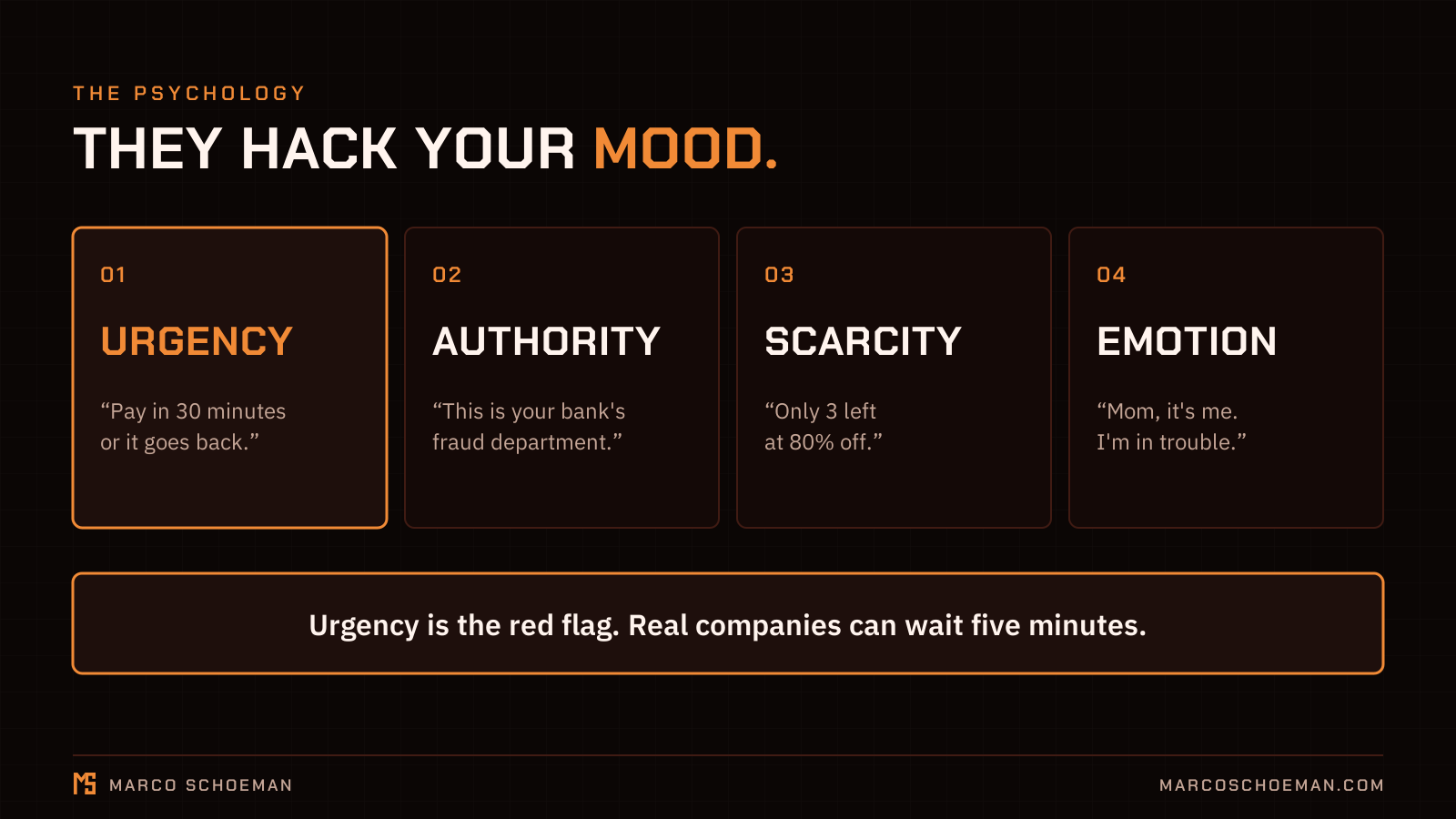
If you remember one thing, make it this: urgency is the red flag. Real companies can wait five minutes while you check. Scammers can't.
1. The fake store
The spelling mistakes are gone. That's the bad news. Scammers now build whole online stores with AI: logos, product photos and reviews, in minutes. NordVPN's threat intelligence team mapped more than 10,000 fake stores copying 166 brands across 26 countries, set up to rank high on Google. Social media ads and deepfake "celebrity" videos push people straight to them.
Four checks before you pay:
- Read the address letter by letter. Watch for "outlet", "sale" or one swapped letter.
- Go direct. Type the brand's address yourself. Don't click the ad.
- Check the payment options. EFT or crypto only, with no card option? Walk away.
- Check the price. 80% off a brand that never discounts isn't a deal. It's bait.
2. "Your parcel is on hold"
Everyone's waiting for a parcel in December, and scammers know it. An SMS or WhatsApp says delivery failed and asks for a small redelivery fee, with a link.
It's never about the fee. It's about your card details. The small amount just makes you relax.
Rule: never pay from a link in a delivery message. Open the courier's app, or check the order with the store you bought from.
3. The call from "your bank"
This is the expensive one, because it doesn't look like a scam. It looks like help.
Your phone rings. The caller ID looks like your bank. A calm, professional voice says they've detected fraud on your account. To protect your money, you need to move it to a "safe account". Or read them the OTP "so they can cancel the transaction".
Victims don't feel robbed. They feel like they're helping. That's how people lose hundreds of thousands.
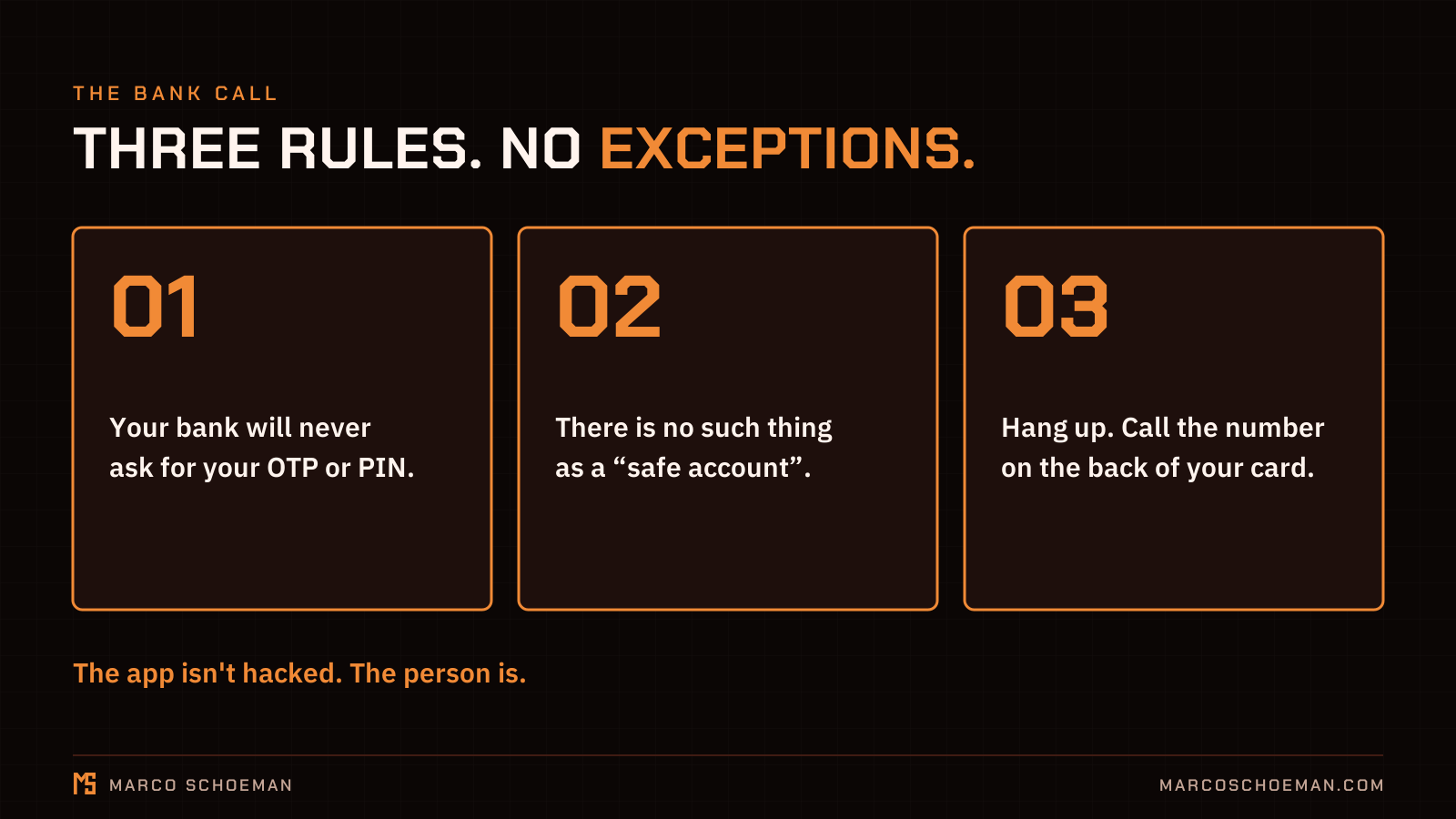
Three rules, no exceptions:
- Your bank will never ask for your OTP or PIN. Ever.
- There is no such thing as a "safe account".
- Hang up and call the number on the back of your card. Not the number they give you.
4. "Mom, it's me": voice clones
AI can clone a voice from a few short clips on social media. The call comes in: crying, panic, an accident or an arrest, "send money now, don't tell Dad". Urgency, secrecy and a voice you love.
The fix takes two minutes. Agree on a family code word: something nobody would guess, never posted anywhere. No code word, no money. Then hang up and call them back on the number you already have.
5. Gift cards
No real company takes payment in gift cards. Not the tax office, not tech support, not "the boss". If someone wants to be paid in gift cards, it's a scam.
Two more traps this season. Tampered cards: criminals record the numbers off physical cards on store racks, then drain them once you load them, so buy digital, direct from the brand. And fake "balance checker" sites that steal the card number.
6. The holiday that doesn't exist
"Sea view. Half price. Pay the deposit by EFT today." You arrive, and there's nothing there. The photos were stolen from a real listing and the reviews were made up.
- Book through a platform that holds your payment.
- Reverse-image search the photos.
- Call the place on a number you found yourself.
- "Deposit today or it's gone" is urgency. You know the rule by now.
7. For business owners: the December invoice
Half the office is on leave. The other half is approving things they didn't read. An email arrives from a "supplier": "We've changed banks, please use the new details." Or the "boss" asks for an urgent payment before year-end.
- Verify every change of banking details by phone, on a number you already had. Not the one in the email.
- Two people approve payments over a set amount. Even in December. Especially in December.
- Tell your team before the break. One message. Two minutes.
The 10-minute festive lockdown
Do this tonight:
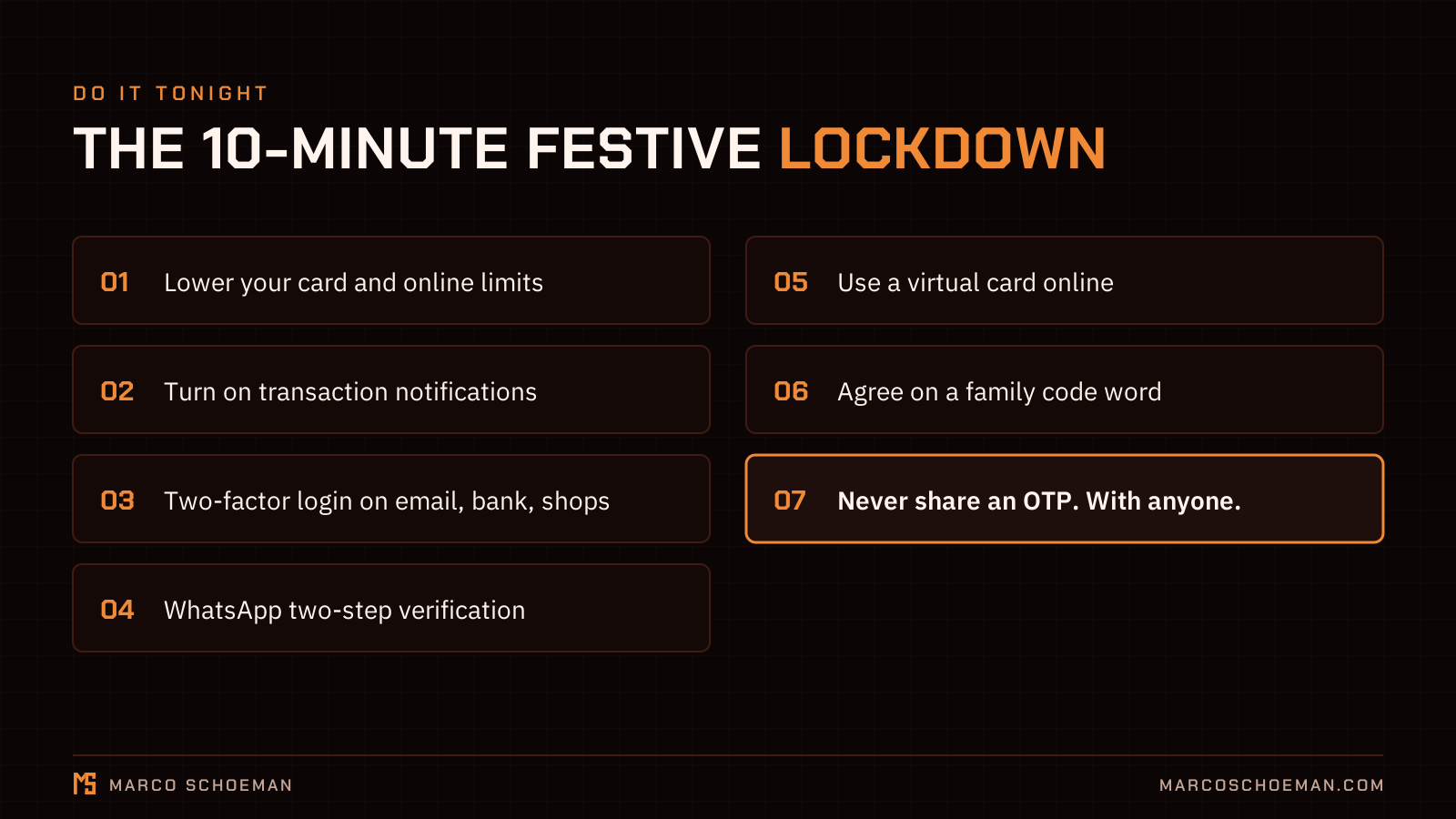
- Lower your card and online limits to your real shopping budget.
- Turn on transaction notifications for every card.
- Turn on two-factor login for email, banking and shopping accounts.
- Turn on WhatsApp two-step verification (Settings → Account → Two-step verification).
- Use a virtual card for online shopping if your bank offers one.
- Agree on a family code word.
- Never share an OTP. With anyone. For any reason.
If it already happened
Speed beats embarrassment.
- Call your bank immediately on the number on your card and ask them to stop the payment.
- Change your passwords from a trusted device, starting with your email.
- Log out of all sessions and turn on two-factor login.
- Report it. In South Africa, open a case with SAPS. In the US, use ic3.gov. In the UK, Action Fraud. Most countries have an official reporting site.
Then watch for the second scam: "We can recover your money, for a fee." The FBI counted around $1.4 billion lost to recovery scams in 2025 alone.
Getting scammed doesn't make you stupid. Not reporting it makes the next victim easier.
The short version
Scammers don't need to be clever. They need you to be busy. So slow down. Five seconds. Check the address. Hang up and call back. Ask for the code word.
Urgency is their tool. Patience is yours.
Sources: FBI IC3 2025 Internet Crime Report; SABRIC 2025 Annual Crime Statistics; NordVPN Threat Intelligence (November 2026). The FBI figures cover the US only, and SABRIC's cover reported cases from participating banks.
General information, not legal or financial advice.

